In a general round of invitations, 2,095 invitations to apply (ITAs) for permanent residency were issued on April 23rd in connection with the most recent Express Entry draw.
At 529, the Comprehensive Ranking System (CRS) score stays quite high.


In a general round of invitations, 2,095 invitations to apply (ITAs) for permanent residency were issued on April 23rd in connection with the most recent Express Entry draw.
At 529, the Comprehensive Ranking System (CRS) score stays quite high.
Date: 16 April, 2024
How to estimate processing times for applications and determine which streams are accepting applications.
Nomination certificate limits
Immigration, Refugees and Citizenship Canada (IRCC) sets the limits for nomination certificates. The AAIP issued 10,029 nomination certificates in 2023, which includes 279 nomination certificates issued under a federally authorized administrative buffer for Express Entry nomination certificates. AAIP’s 2024 allocation has not yet been confirmed. Notional increases to more than 10,000 nomination allocations per year are expected in 2024 and 2025. Additional information about the 2024 allocation and the projected split between Express Entry and non-Express Entry pathways will be provided when available.
In an official announcement, Canada’s immigration minister, Marc Miller, stated that the country hopes to grant 235,600 new study permits by the year 2024.
Additionally, the cap of 392,667, which is based on a 60% approval rate, is set for new study permit applications (apart from those pursuing master’s or doctoral degrees and those in primary and secondary education).
A comprehensive province-by-province provincial attestation letter and study permit approval allotment for 2024 were also provided by the minister (mentioned in the later portion of this article).
By 2024, Canada hopes to have granted 485,000 study permits in total. This comprises about 97,000 Canadian study permit extensions.
The immigration service estimates that 606,000 applications for study permits (including extensions and other variations) will be received overall in 2024.
Study Permit Allocations by Province, 2024
The study permit allocations and anticipated approvals for applications are listed below; students pursuing master’s or doctoral degrees as well as those in elementary and secondary education are not included.
Allocation After Initial Adjustment | Final Allocation After Top-Ups for PTs with Approval Rate Below 60% | |||||
| Province / Territory | PT Allocations (A) | Projected SPs Approved (B) | % Change from 2023 | Top-Up (C) | Revised PT Allocations with Top-Up (A+C) | Projected SPs Approved (same as B) |
| Alberta | 40,894 | 24,537 | 10% | N/A | 40,894 | 24,537 |
| British Columbia | 83,000 | 49,800 | -18% | N/A | 83,000 | 49,800 |
| Manitoba | 15,233 | 9,140 | -10% | 3,420 | 18,652 | 9,140 |
| New Brunswick | 9,279 | 5,567 | -10% | 5,372 | 14,651 | 5,567 |
| Newfoundland and Labrador | 2,365 | 1,419 | 10% | 788 | 3,153 | 1,419 |
| Northwest Territories | 333 | 200 | 4900% | N/A | 333 | 200 |
| Nova Scotia | 12,906 | 7,744 | -10% | 7,472 | 20,378 | 7,744 |
| Nunavut | 333 | 200 | 6567% | N/A | 333 | 200 |
| Ontario | 235,000 | 141,000 | -41% | N/A | 235,000 | 141,000 |
| Prince Edward Island | 2,004 | 1,202 | -10% | 308 | 2,312 | 1,202 |
| Quebec | 72,716 | 43,629 | 10% | 45,202 | 117,917 | 43,629 |
| Saskatchewan | 12,043 | 7,226 | 10% | 3,011 | 15,054 | 7,226 |
| Yukon | 417 | 250 | 205% | N/A | 417 | 250 |
| Total | 486,523 | 291,914 | -28% | 65,572 | 552,095 | 291,914 |
In this scenario, the number of students in 2024 would be higher in some provinces and territories than in 2023, while it would be lower in others.
How long does it take the IRCC to process research permits?
According to the most current IRCC processing update, the average processing time for study permit applications is 11 weeks for those from outside Canada, 10 weeks for those from within, and 77 days for study permit extensions.
The Immigration, Refugees and Citizenship Canada (IRCC) has declared that, as of April 30, 2024, all applications for permanent residency in Canada will cost higher immigration fees.
Since 2020, the IRCC has raised immigration costs every two years; the current price hike is larger than the one from 2022.
The fees increased by a relatively small amount, to approximately 3%, in April 2022. The new rates, which take effect on April 30, 2024, are almost 12–13% higher.
The new rate is based on the Consumer Price Index’s cumulative percentage rise over the two preceding years (2022 and 2023), as reported by Statistics Canada, and is rounded to the closest five dollars.
All applicants for permanent residence are exempt from paying the Right of Permanent Residence Fee, with the exception of dependent children and protected individuals.
Under certain circumstances, principal applicants in the categories of “humanitarian and compassionate” and “public policy” are exempt from paying the Right of Permanent Residence Fee.
Family members cannot apply for permanent residency on behalf of the “Permit Holder” class. Those falling under this category are required to apply on their own as principal applicants.
| Program | Applicants | New fees (April 2024–March 2026) | Current fees (April 2022– March 2024) | Previous Raise (2020-2022) |
| Right of Permanent Residence Fee | principal applicant and accompanying spouse or common-law partner | $575 | $515 | $500 |
| Express Entry Federal Skilled Workers, Provincial Nominee Program, Quebec Skilled Workers, Atlantic Immigration Class and most economic pilots (Rural, Agri-Food) | Principal applicant | $950 | $850 | $825 |
| Accompanying spouse or common-law partner | $950 | $850 | $825 | |
| Accompanying dependent child | $260 | $230 | $225 | |
| Live-in Caregiver Program and caregivers pilots (Home Child Provider Pilot and Home Support Worker Pilot) | Principal applicant | $635 | $570 | $550 |
| Accompanying spouse or common-law partner | $635 | $570 | $550 | |
| Accompanying dependent child | $175 | $155 | $150 | |
| Business (federal and Quebec) | Principal applicant | $1,810 | $1,625 | $1,575 |
| Accompanying spouse or common-law partner | $950 | $850 | $825 | |
| Accompanying dependent child | $260 | $230 | $225 | |
| Family reunification (spouses, partners and children; parents and grandparents; and other relatives) | Sponsorship fee | $85 | $75 | $75 |
| Sponsored principal applicant | $545 | $490 | $475 | |
| Sponsored child (principal applicant under 22 years old and not a spouse/partner) | $85 | $75 | $75 | |
| Accompanying spouse or common-law partner | $635 | $570 | $550 | |
| Accompanying dependent child | $175 | $155 | $150 | |
| Protected persons | Principal applicant | $635 | $570 | $550 |
| Accompanying spouse or common-law partner | $635 | $570 | $550 | |
| Accompanying dependent child | $175 | $155 | $150 | |
| Humanitarian and compassionate considerations and Public policy | Principal applicant | $635 | $570 | $550 |
| Accompanying spouse or common-law partner | $635 | $570 | $550 | |
| Accompanying dependent child | $175 | $155 | $150 | |
| Permit holders | Principal applicant | $375 | $335 | $325 |
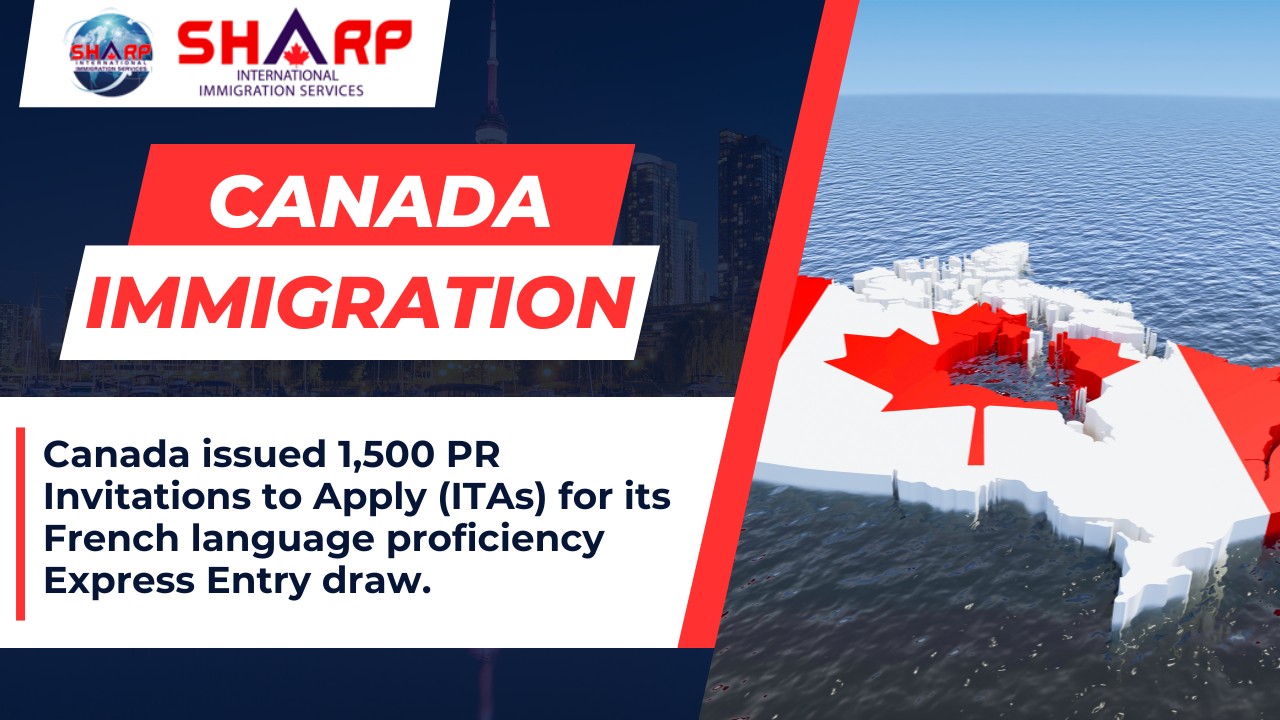
Canada issued 1,500 Invitations to Apply (ITAs) for its French language proficiency Express Entry draw.
The March 26 draw produced a minimum Comprehensive Ranking System (CRS) score of 388 points, which was 52 points better than the previous French language proficiency draw.